Contact:Mr. Sun Ling
Email:meng@shandonghg.com
whats app:+86-15863158497
Add:: No. 2228 Tianchen Road, Jinan, China
In the quiet hours before dawn, when the only sound is the gentle hum of a cooling wort and the soft clink of stainless steel settling into its nightly repose, a transformation occurs. It is not merely the chemical conversion of sugar to alcohol, but the birth of a narrative. Every batch of beer holds the potential to tell a story—of heritage, of rebellion, of community.
As a brewmaster, a production manager, or the visionary owner of a rising craft beer empire, you understand this intimacy. You know that the vessel in which this narrative unfolds is not just a piece of industrial equipment; it is the stage upon which your reputation is built.
When we look at the landscape of modern brewing—whether you are scaling a nano-brewery into a regional powerhouse, or engineering a greenfield production facility—we often see a singular focus on capacity. “How many barrels?” is the first question. But the more profound, often unasked question should be: “How will this equipment respect my recipe?”
For the procurement manager, the calculus of a new brewery line is typically one of logistics: lead times, shipping weights, and compliance certifications. For the brewmaster, it is an emotional calculus. Will this mash tun offer the same thermal stability that allowed my Hefeweizen to win that gold medal in 2022? Will the lauter tun’s design honor the delicate protein rest of my Pilsner?
This duality—the balance between commercial efficiency and artistic integrity—is where the true value of a manufacturing partner is revealed.
We have spent decades observing a specific pattern in the industry: breweries that thrive are those that treat their equipment acquisition not as a capital expenditure, but as a creative collaboration. When you are sourcing from overseas, the distance between your brewhouse and the factory floor matters. Not the geographic distance, but the philosophical one.
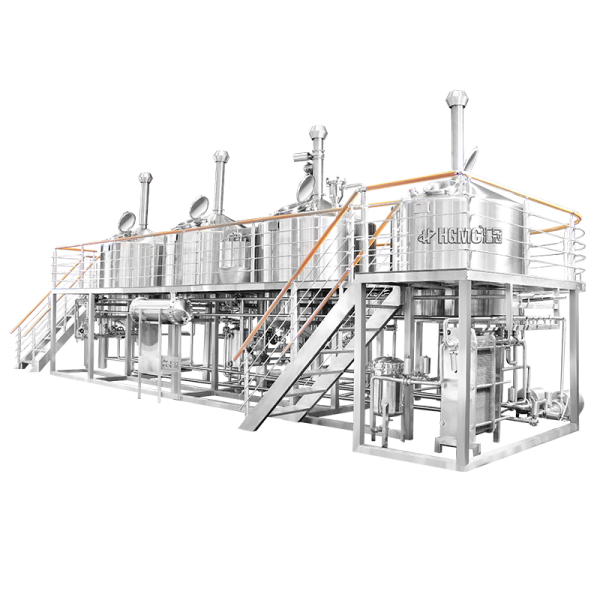
Consider the anatomy of a high-performance brewhouse. It is easy to get lost in the specifications—the millimeter thickness of the dimpled jackets, the polish of the interior welds, the efficiency rating of the steam condensers. These are the necessary metrics of a functional machine. But a great brewery feels different.
It feels different because the engineering anticipates the brewer’s movement.
A well-designed raking system does not simply stir grain; it mimics the gentle hand of an experienced mash master. A kettle designed for optimal whirlpool separation does not just clarify wort; it preserves the fragile volatile oils that give your IPA its soul. These nuances are not found in a price-per-liter spreadsheet. They are found in the design philosophy of the manufacturer.
For the engineer tasked with maintaining this system, the difference lies in accessibility. Is the control panel designed with intuitive redundancy? Are the sanitary fittings placed where a human hand can actually reach them without contortion? When a manufacturer builds with the maintenance crew in mind, they aren’t just selling a tank; they are selling uptime, safety, and the sanity of your technical staff.
In the current market, the conversation inevitably turns to sustainability. However, true sustainability is not a sticker placed on a control panel; it is embedded in the metallurgy and the thermal dynamics.
A brewery that reduces water consumption by 15% does so because the CIP (Clean-in-Place) system was engineered with precision, not because of a software update. A facility that cuts energy costs by 20% achieves this because the insulation on the fermentation vessels and the heat recovery systems were designed with a holistic view of the brewing cycle.
When you partner with a manufacturer who treats energy efficiency as a foundational principle rather than an accessory, you are future-proofing your business. You are preparing for a market where the cost of energy will only become more volatile, and where the discerning consumer increasingly asks about the carbon footprint of their pint.
We know that stepping into the global market to source equipment can feel daunting. There is the risk of miscommunication, the fear of “spec creep” where costs spiral, and the anxiety of a container arriving with a crucial component out of tolerance.
This is why we view our role as something greater than a vendor. We are the custodians of your ambition.
Before a single sheet of 304 stainless steel is cut in our facility, we want to understand your brewery. We want to know about the water profile in your city. We want to know if you are chasing high-hop saturation or the delicate crispness of a traditional lager. We want to see your floorplan, not just to fit the tanks, but to optimize the flow of your brewers from the mill to the bright tank.
As you look toward your next phase of growth—whether that is adding a few 60-barrel fermenters to keep up with distribution demand, or constructing a fully automated 200-hectoliter brewhouse that runs with surgical precision—we invite you to look beyond the metal.
You are not just buying tanks. You are buying the ability to sleep soundly knowing that your brewers are safe, that your yields are maximized, and that the integrity of your flagship IPA will remain unchanged, batch after batch, for the next twenty years.
The world of craft beer is crowded. The margins are tight. The consumers are sophisticated. To stand out, your product must be exceptional. But the foundation of that exceptionalism is not found in a marketing budget; it is found in the quality of the tools you use to create it.
Let’s build the infrastructure that lets your creativity flow without interruption.
Ready to scale your vision with precision engineering?
Tell us about your current capacity and your goals for the next five years. Our team of engineers and brewing specialists is ready to walk you through a customized layout that respects your space, your recipe, and your legacy.
[Request a Consultation]
ADDRESS No. 2228 Tianchen Road, Jinan, China
Copyright @ 2026 Shandong Huiguan Engineering Equipment Co., Ltd.