Contact:Mr. Sun Ling
Email:meng@shandonghg.com
whats app:+86-15863158497
Add:: No. 2228 Tianchen Road, Jinan, China
Search “fermenter design” and you will find endless discussions about jacketing, insulation, and pressure ratings. But one parameter that procurement managers and engineers often overlook—until it is too late—is the cone angle.
Question: “What is the ideal cone angle for a fermenter?”
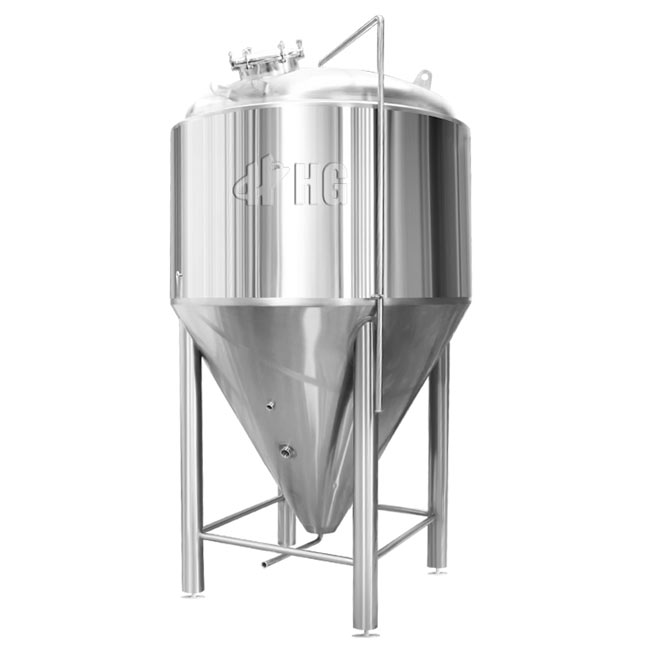
Between 60° and 70° from horizontal. Shallower than 60°, and yeast and trub do not slide cleanly to the bottom—they accumulate on the cone walls, creating a “ring” of sediment that is difficult to harvest and becomes a breeding ground for autolysis flavours. Steeper than 70°, and the tank becomes unnecessarily tall, increasing your building height requirements and making CIP access more difficult.
Why 65° is the engineering sweet spot
At 65°, yeast sedimentation follows a predictable exponential curve—the majority of yeast settles within the first 48 hours, allowing for clean cropping without disturbing the trub layer. This is critical for brewers who repitch yeast: a clean harvest means consistent vitality and attenuation from batch to batch.
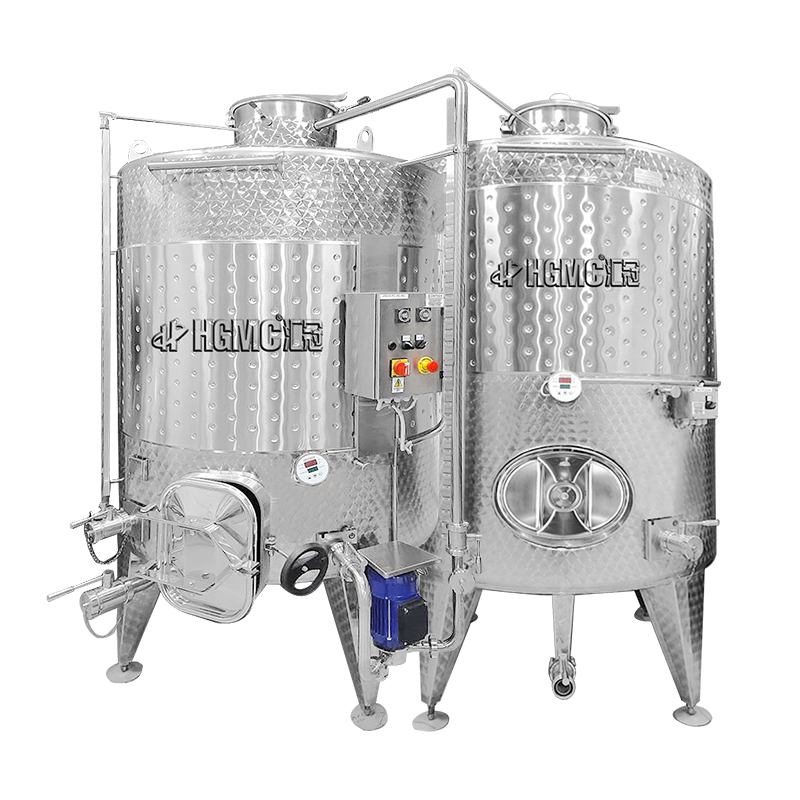
But cone angle is not just about yeast. It is also about thermal performance. A steeper cone has less surface area per unit volume, which means less heat exchange surface in the cone zone—the area where fermentation activity is highest. Our tanks use a zoned jacket that covers both the cylinder and the cone, with independent glycol flow control for each zone. This allows you to cool the cone more aggressively during the peak fermentation phase, controlling the exothermic reaction without overcooling the main body.
Question: “What about the cone-to-cylinder ratio—does that matter?”
Absolutely. A fermenter with a cone that is too small relative to the cylinder will have a shallow sediment bed, making it difficult to draw off yeast without also pulling trub. We calculate the cone volume as a percentage of total tank volume: for a 20hL fermenter, the cone should represent 12–15% of total capacity. This ensures a deep enough sediment cone for clean cropping.
Question: “How do I know if my fermenter’s geometry is right for my beer styles?”
Lagers require longer conditioning times and benefit from a slightly steeper cone (65–68°) to promote compact sedimentation. Ales, with their shorter turnaround, can use a 60–62° cone. Our design process includes a style-specific geometry calculation—we adjust the cone angle and cylinder height based on your typical fermentation schedule and yeast strain.
The unseen cost of poor geometry
A fermenter with the wrong cone angle will frustrate your brewers every single batch. Yeast cropping becomes a guessing game. Trub carryover increases. Fermentation times drift. And over five years, that frustration translates into lost productivity, higher labour costs, and inconsistent beer.
We do not guess. We calculate.
→ Share your typical beer styles and fermentation schedule. Our engineering team will send a fermenter geometry recommendation—including cone angle, cylinder height, and jacket coverage—tailored to your production goals.
ADDRESS No. 2228 Tianchen Road, Jinan, China
Copyright @ 2026 Shandong Huiguan Engineering Equipment Co., Ltd.